Monday, November 9, 2015

Griffin's Mid Unit Post

The art piece that the rest of these images will be related to is an art piece on display at the North Carolina Museum of Art in Raleigh called "Bride", a sculpture by Beth Lipman.

A still life image is a painting, photograph, or any manner of expression which depicts inanimate non-human objects as art. As The Art Factory puts it, still life “captures the natural beauty of transient objects like flowers or fruit or table elements… to express the abstract qualities of the visual elements”. Still life traditionally depicts typical objects you’d find in your house, usually set up on a coffee table or breakfast table. Still life is one of the most famous painting forms since it was incredibly popular around the turn of the 20th century. Beth Lipman’s art is reminiscent of still life, except in sculpture form. Much of her work, and especially “Bride” is modeled after still life in the way that she creates still life images out of glass. She doesn’t imitate others work at all, but she definitely is unique in her interpretation of sculpture as still life. 


A traditional object synonymous with wedding ceremonies for centuries, the wedding cake itself is essentially a universal  symbol for togetherness. As you can see by comparing the 2 photos, Lipman’s sculpture, “Bride”, is shaped similarly to a wedding cake with the multiple layers gradually getting smaller as the sculpture gets taller, just as a wedding cake does. This leads you to believe the sculpture has a theme of a wedding, a theme of a ceremony, or a theme of love. Also contributing to this is the fact that the sculpture is called “Bride”. I have a hard time believing the 2 aren’t related. 


Further going into the topic of weddings, I was immediately drawn to the use of glass in this piece. The pieces on the upper layer are unbroken while the pieces on the lower layers are completely shattered. I started to think that this was for the purpose of symbolizing a broken marriage since the 10 foot piece was in the shape of a giant cake. Then, in researching more, Beth Lipman, the artist behind this piece, has a jewish name. Without dragging religion into this, and its kind of unavoidable when talking about marriage as its inherently what marriage is, the jewish religion has a history with breaking glass as a sign of marriage. Traditionally, a glass is shattered at a jewish wedding to symbolize the marriage of 2 individuals. So, depending on her message, the shattered glass could either be a symbol of broken marriage or, maybe less obviously, a positive symbol of new beginnings.


William Hargett Unit 4 Mid Unit Post

http://history.howstuffworks.com/history-vs-myth/paul-revere-ride.htm This photo is of the  famous Paul Revere spreading the word that British troops were approaching. Although Revere did help to spread the word, it was not nearly as dramatic as the legend suggests. This is relevant to my piece of art because it shows the most famous minute man of all time at work.  It also provides a talking point as there are differences between common beliefs and fact concerning Paul Revere.    

http://www.lexingtonhistory.org/books.html
This picture (obviously) is of the battle of Lexington. This photo is relevant to my piece of art because the piece of art is about the riders warning the civilians and instructing the minutemen to get ready for battle. The photo shows the battle fro the colonists side firing into the redcoat organized lines. The British won the battle. 

This picture is critically important to my piece of art. It shows a minuteman getting ready for war, which is also seen in my photo. In my photo, the minutemen are scrambling for their weapons and ready to get to the battle, as the messenger in the photo is describing to them. Minutemen were a critical part of the American Revolution.

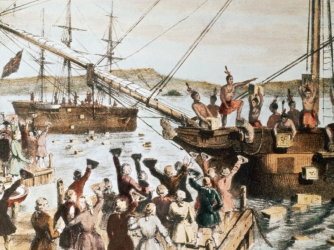
This picture is of the Boston Tea Party. The Boston Tea Party was a major event that contributed heavily into the start of the Revolutionary War (at Lexington). This was one of the final boiling points that made tensions to high without there being bloodshed.
This photo is also crucial to my piece of art. It is another piece of the puzzle that led to the boiling over of the tension between the colonists and the British. It also led to the Boston Tea Party as well. The tea tax was a huge contributor to the start of the Revolutionary War.


Friday, November 6, 2015

American Influences on Christian Culture

Works Cited


Kretschmann, R., & Benz, C. (2012). Morality of Christian Athletes in Competitive Sports - A Review. Sport Science Review, XXI(1-2), 15-15. doi:10.2478/v10237-012-0001-y


Carpenter, J. (2009). Passing the Plate: Why American Christians Don't Give Away More Money. By Christian Smith and Michael O. Emerson, with Patricia Snell. New York: Oxford University Press, 2008. xiv 274 pp. $24.95 cloth. Church History, 79(03), 709-709. doi:10.1017/S000964070999031X


Hull, J. (2000). Money, Modernity, And Morality: Some Issues In The Christian Education Of Adults.     Taylor & Francis Ltd. Religious Education, 95(1), 3-22. Retrieved October 30, 2015, from http://search.proquest.com.prox.lib.ncsu.edu/docview/199373601/citation?accountid=12725


Werpehowski, W. (1991). Christian Love and Covenant Faithfulness. The Journal of Religious Ethics,  Blackwell Publishing Ltd, 19(2), 30-30. Retrieved October 30, 2015, from http://www.jstor.org.prox.lib.ncsu.edu/stable/40015133?pq-origsite=summon&seq=1#page_scan_tab_contents


Walks, S. (2008). Money or Business? A Case Study of Christian Virtue Ethics in Corporate Work. Christian Scholar's Review, 38(1), 15-40. Retrieved October 30, 2015, from http://search.proquest.com.prox.lib.ncsu.edu/docview/201364302?pq-origsite=summon

Tuesday, November 3, 2015

The Real Benefits of Gaming

Works cited

Graves, William. J. Reality Check: Perception of Cognitive Ability of Video Game Players. Proceedings of the Human Factors and Ergonomics Society Annual Meeting.  

Kowert, Rachael. (2014, Mar 4). Unpopular, Overweight, Socially Inept: Reconsidering the 
Stereotype of Online Gamers. Cyberpsychology, Behavior, and Social Networking.  Retrieved from

Mozes, Alan. (2013, Jan 10). Survey Refutes ‘Loner’ Stereotype of Video Gamers. US News and World Report Retrieved 

Rodriguez, Ashley. (2015, Aug 3). Gaming Goes mainstream as Stereotypes Dissapear: How to 
reach gamers — an affluent, young and fast growing consumer segment. Advertising Age. Retrieved from 

Williams, Dimitri. (2008, Sep 2). Who plays, how much, and why? Debunking the stereotypical 


gamer profile. Journal of Computer Mediated Communication. Retrieved from  http://onlinelibrary.wiley.com.prox.lib.ncsu.edu/doi/10.1111/j.1083-6101.2008.00428.x/full 

Is Sampling Real Music?


Is Sampling Real Music?

Works Cited

       Ronson, M. [Published by TED]. TED. (2014, May 09). How Sampling Transformed Music. 
Retrieved from https://www.youtube.com/watch?v=H3TF-hI7zKc

       Kruglanski, A.W.. (2004). [The Psychology of Closed Mindedness]. New York: Psychology Press, 2004.
ISBN: 978-0863775802

       Rosati, J.. (2006). [Review of The Psychology of Closed Mindedness]. JSTOR. Political Psychology, 27(3), 506–509. 
Retrieved from http://www.jstor.org/stable/3792463

       Garfield, D., Shockley, H., & McLeod, K. (Writers). (2011, January 28). NPR. Digital Music Sampling: Creativity or Criminality? [Radio broadcast]. In Talk of the Nation. Washington, D.C.: National Public Radio.
Retrieved from http://www.npr.org/2011/01/28/133306353/Digital-Music-Sampling-Creativity-Or-Criminality

       Ronson, M., & Raz, G. (Writers). (2014, June 27). TED. Why Would More Than 500 Artists Sample The Same Song? [Radio broadcast]. In TED Radio Hour. Washington, D.C.: National Public Radio.
Retrieved from http://www.npr.org/2014/06/27/322721353/why-would-more-than-500-artists-sample-the-same-song

       Kimble, J. (2013, May 21). HipHopdx. All Samples Cleared: The importance and Rules of Hip Hop Sampling. Retrieved October 29, 2015.
Retrieved from http://hiphopdx.com/editorials/id.2118/title.all-samples-cleared-the-importance-rules-of-hip-hop-sampling

Sunday, October 25, 2015

William Hargett Unit 3 Mid Unit Post


In sixth grade, I received an Xbox 360 for Christmas. From that moment on, I definitely considered myself a gamer. Each day, I would go home after school and play a few hours online with my friends. My weekends were also dominated with Xbox, specifically Call of Duty. When I asked the members of my group in ENG 101 to say some qualities of a gamer, I received many responses, most being negative. Most answers involved describing gamers as lazy couch potatoes that never leave their house. My research has reinforced my belief that this stereotype is not true. Countless studies have been made regarding this topic and the evidence consistently shows how the video game industry is growing and that they can increase both hand eye coordination and the ability to track objectives. First person shooter video games also increase reaction time, as a player has to react and aim to his target moving across the screen. Most research cites the cognitive benefits of video games, with few citing the social benefits. The main benefit I received from video games was the social benefits of constantly being able to talk with my friends. Running home each day after school, I was pretty excited to play the game itself, but I really just wanted to hang out with my friends. Typically, I would only play if my friends were also online. Today, I definitely still enjoy playing good video games. However, I would not classify myself anywhere near the gamer status that I was a part of in middle school.

Friday, October 23, 2015

Hunter's Autoethnography Research

I have identified with being a christian since I was around the age of five, and it is one of the main pieces of my life that defines who I am. When asking what assumptions people have toward christians I received some interesting answers. I would ask first off if they identified as christians, and the ones who did not belong to my group were very kind and sensitive when referring to the christian group as a whole. Out of convenience on my part I asked a few people around me, I knew had a christian background, about their assumptions. It was their responses that led me to my topic in my autoethnogragphy. One person gave me adjectives for christians such as religious and scared. Others in general told me that they were christians but they don't go to church or anything like that. From outsiders looking into this group they might see christians on what they have become rather than what they should be. Through my research I have found there are various studies regarding christians and their behavior in the work place or in the field of sports. Using these behavioral conclusions will help me to distinguish the line that constitutes what it means to be a christian. I will also look at the effects that the culture has on beliefs as we grow up and also how we form our definition of a christian. From my personal experience within the group I hope to give an insider perspective on the beliefs that christians hold as well as emphasizing that perfection is not required to be in the group.